Our ever popular One Hour Series is back for the remainder of 2022.
Meet your CPD requirements on a regular basis throughout the year. Join the debate on the day, or listen back to the recorded session at a time that suits you. Our One Hour Series is a cost effective and time efficient way to keep up to date with the statutory framework and current regulatory approach.
• Business Insolvency: Leases, Landlords and Hypothec (Scotland) – Friday 30 September
• Technical Short: Personal Pensions in Personal Insolvency – Friday 28 October
• Business Insolvency: Insolvency of a Charity – Friday 25 November
£50 + VAT per session (50% reduction for every third one hour session you book).
Email: [email protected]
Phone: 0845 601 7570
The business
Insolvency Support Services is an award-winning provider of a uniquely complete range of support services, including training, outsourcing, compliance and practice support, to the UK insolvency market ( e.g. professional practices, regulators, local and national government). Our offering includes face-to-face, online and client-site training courses; independent compliance reviews; practical case progression; technical support; ad-hoc closure programmes; provision of document packs and checklists and support on complex insolvency case matters.
Due to client demand for our services, we are looking to expand our team with the addition of an experienced, skilled and enthusiastic insolvency professional.
The role
Key responsibilities for this role will include:
Skills preferred
Ideally candidates will:
Benefits
Application
To apply, please forward your CV to [email protected] with a short statement of no more than 500 words, setting out your suitability for the role.
Candidates wishing a more detailed job description may request this before formally applying. Please contact [email protected] to do so.
We encourage applicants from all backgrounds and communities, and we do not discriminate on the basis of a person’s gender, ethnicity, disability, sexual orientation or any other protected characteristics. Please let us know if you require any adaptations to allow you to apply for this post.
Applications should be submitted before 23:59 on Friday 9 September 2022.

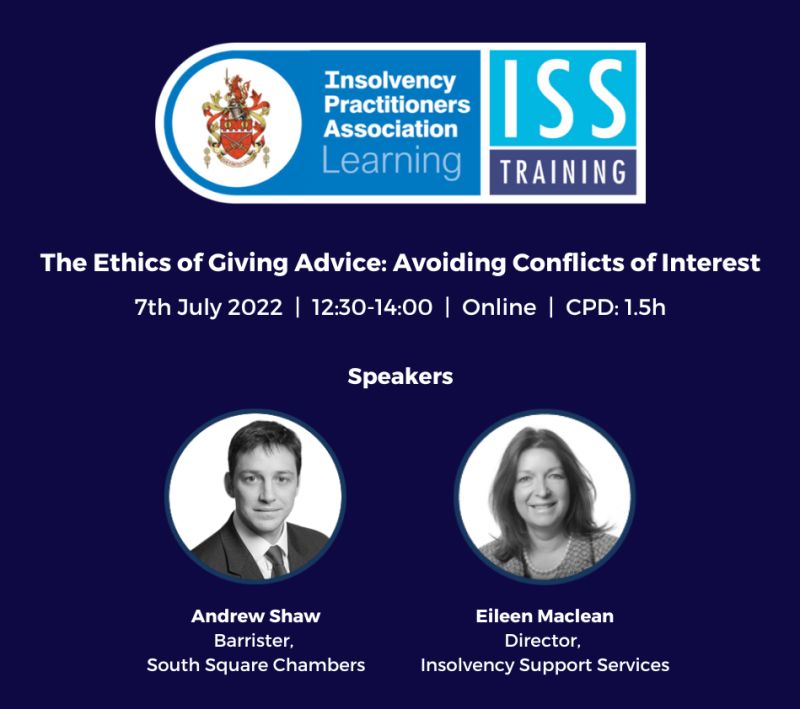
Insolvency practitioners face an inherent conflict of interest in giving advice to an individual or company before accepting a subsequent appointment as office holder. We need to find an approach that allows us to build a relationship with a prospective appointment, while ensuring that they understand the consequences of that very appointment and our role once formally in office.
Concentrating on issues commonly identified by the IPA’s Regulation and Monitoring teams, the next IPA Learning session on 7 July (12:30-14:00) looks at how insolvency practitioners can get their approach to giving advice in insolvency right.
Our director Eileen Maclean is looking forward to speaking at the event alongside Andrew Shaw of South Square.
Insolvency Support Services is pleased to support FRP’s Scottish Technical Manager Forum, which enjoyed its inaugural meeting in April 2022. It’s an opportunity for anyone responsible for Scottish case compliance or technical support to come together on a regular basis and discuss current or common issues faced in Scottish insolvency appointments.
The next meeting is scheduled for Wednesday 7 September. Given the geographical spread of group members, it will be held online.
If you would like to attend, or get notice of future meetings, please contact Danielle Kelly at [email protected] or FRP’s Jenna Cooper at [email protected]. We will make sure that you are added to the mailing list.
After the challenges of the pandemic and a busy couple of years since, we’ve decided to take a health and wellbeing week in July, so the team here at Insolvency Support Services will be enjoying an extra week’s holiday from Monday 11 July to Friday 15 July. The business will be closed for those five days to allow us a week of R&R and as a thank you to the team for all their hard work and support.
We hope that by letting you know now, we won’t inconvenience our clients. We will be back, bright and refreshed, on Monday 18 July.
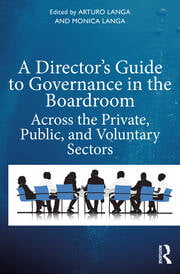
Our director Eileen Maclean is a contributing author to the recently published “A Director’s Guide to Governance in the Boardroom”.
Edited by Arturo and Monica Langa¸ it is an essential, practical guide for both experienced and aspiring executive and non-executive directors to lead, govern, and steer UK-based organisations. It will also prove extremely valuable for those who provide board evaluation services, professional advisers, auditors, and those who provide training and other support for board members.
To find out more and purchase a copy of ”A Director’s Guide to Governance in the Boardroom”, click here.
Our Director Eileen Maclean is taking part in the Edinburgh Insolvency Discussion Group Panel Session on 25 February on the potential changes set out in the Government’s consultation “Future of Insolvency Regulation”. It is very important that the profession engage in the consultation. The aim is to strengthen and modernise the insolvency regulatory regime which has been in place for 30 years.
Joining Eileen on the panel will be Shona Campbell, Henderson Loggie, David Menzies, ICAS, and Paul Dounis, RSM UK.
To book your place and submit questions, please email Danielle Kelly at [email protected]
The consultation closes at 11:59pm on 24 March 2022.
Insolvency Support Services Director Eileen Maclean is looking forward to delivering the first IPA Learning online module of 2022 next month.
The “How do you translate the statutory AML requirements into meaningful, effective application?” session will take place on 22 February 2022 from 12:30 until 14:00.
We will cover how:
Do you want to benefit your insolvency practice by implementing efficient procedures to meet AML legal requirements? Book here
Debt, and the Scottish statutory solutions that exist to deal with individual overindebtedness, has the perpetual attention of the Scottish Government and the wider Scottish Parliament.
In 2018 the Scottish Parliament’s Economy, Energy & Fair Work Committee refused to approve legislation replacing the common financial statement with the standard financial statement as the statutory common financial tool (CFT) in Scottish legislation. In response, in December 2018 Jamie Hepburn MSP, the Minister for Business, Fair Work and Skills, established the Scottish Statutory Debt Solutions Discussion Forum.
The Forum enables stakeholders, including insolvency practitioners (IPs), creditors and the advice sector, supported by officers from the Accountant in Bankruptcy (AiB), to discuss current issues around Scotland’s statutory solutions for personal insolvency and debt management.
Following its consideration of the CFT and because of concerns arising therefrom, the committee turned its attention to protected trust deeds (PTDs) at the end of November 2019, conducting a short, PTD-focused inquiry in January 2020.
In May 2020, the committee published its recommendations and the Scottish Government responded in October 2020. A three-stage approach to review, improve and/or change was agreed, starting with introductory round table discussions, which will lead ultimately to a full review of the purpose and functionality of Scottish debt solutions.
Stage 2 saw the establishment of three working groups, tasked with the specific remit of considering PTDs, bankruptcy and diligence. The Society and the Insolvency Practitioners Association (IPA) are represented on group 2, considering certain of the committee’s areas of concern regarding PTDs. The discussions are wide ranging, reflecting divergent points of view.
In direct response to the committee’s report on PTDs, the AiB, working with the IPA as the foremost regulator of IPs providing PTDs, developed and introduced a new PTD Protocol, introducing operational changes to immediately address some of the committee’s recommendations.
Intended to promote good practice, improve transparency and enable trustees to manage debtor and creditor expectations in a PTD, trustees signing up to the Protocol agree that wherever practicable:
To date, eight firms have signed up, but with a reach of more than 80% in terms of the volume of providers.
The committee took evidence on one specific case in which the debtor had died leaving behind a number of ramifications of an extant PTD for their beneficiaries. Group 2 was asked to consider whether PTD arrangements strike the appropriate balance between creditors and family members when a debtor’s death occurs during a PTD.
If a debtor dies during their bankruptcy or PTD, there is no change in the statutory requirement for the trustee to deal with assets of the estate. The trustee is still required to deal with creditor claims ahead of recognising any rights and entitlements of beneficiaries, per s 129 of the Bankruptcy (Scotland) Act 2016. The principle that creditors get paid ahead of beneficiaries or partners is well established – the law recognises that debt is a responsibility and that wherever possible, creditors should be repaid ahead of any individual benefitting in a personal capacity, as a beneficiary. The group agreed that the repayment of debt to creditors ahead of beneficiaries from a deceased’s estate is well established in different areas of the law and unanimously agreed that no changes are required to this principle.
Group 2 recommended that the Scottish Government publication What to do after a death in Scotland be amended to explain the process where a debtor dies while subject to a PTD or bankruptcy. Ideally that wording should make it clear that an executor should check the Register of Insolvencies and the Debt Arrangement Scheme (DAS) register, for details of both the deceased and the beneficiaries, to establish whether any party is subject to insolvency or a debt payment programme before any money is paid out from the estate, to ensure that funds are not released to any party without reference to the trustee. The group has also recommended incorporating this process into legislation to ensure that such a check by executors is mandatory. It would be considered good practice therefore in any executry that this process should be adopted on a voluntary basis from now on.
Authors: Anne Hastie, Law Society of Scotland Administrative Justice Commitee member, and Eileen Maclean, director of Insolvency Support Services and Insolvency Practitioners Association Standards, Ethics and Regulatory Liaison Commitee member.
Our director Eileen Maclean is looking forward to chairing Mackay Hannah’s upcoming Scottish Business Navigation webinar in partnership with Morton Fraser: “Scottish businesses: meeting the first challenges of returning to normal”.
The webinar will be taking place on Monday, 1 November, 10am – 11am (and it is also possible to purchase the recording, if you are unable to attend at that time).
Morton Fraser’s Yvonne Brady, Head of Strategy, Restructuring & Insolvency, will be speaking on how we can help businesses abseil rather than jump over the edge back to normal. In addition, her colleague Alan Meek, Head of Restructuring and Insolvency & Corporate Partner, will be speaking on what the core issues are for businesses facing severe change and challenges.
For more information and to book, click here.